
We’ve called this post How to hide a TV, but the principles apply to any home entertainment, Audio-Visual (AV), media hub or IT equipment which detract from the homeliness of home.

If you are retrofitting to an existing layout, the ideas below will help. If you are about to embark on a renovation, make sure you design and specify the layout for your home network and entertainment system before works commence. We return to this later.
TV alcove units
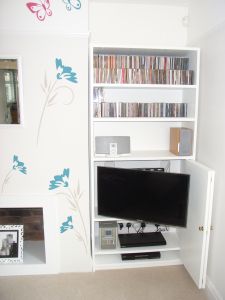

Traditional British homes present a challenge with their central chimney breast and alcoves. If you are looking at how to hide a TV, here is one solution. We design and fit alcove units with TVs on hinged brackets as in the example above. The cupboard also houses the AV equipment and hides the wires, whilst the bifold doors open to one side only for clear viewing. Having determined the number of sockets, their heights and locations, we calculate the location and spacing of each shelf with cut-outs at the rear for plugs and cables.
For surround sound, this asymetric design is not ideal but you can improve this by adjusting the balance between speakers. Remember that in a typical living room, surround sound will be received differently, depending on where you are actually sitting; even when the system is symmetrical. Surround sound systems come with a microphone to calibrate the speakers when you are sitting in the optimum position.
TV wall units
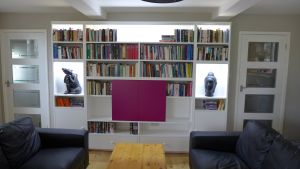

For homes that do have a symmetrical layout, you might consider installing a complete wall unit with sliding doors. In the example above, our client asked if we had any thoughts on how to hide TV; so we designed and fitted this with the doors painted traffic purple to match the kitchen splashback. The depth of typical AV equipment would have caused the cabinet to protrude too far into the room, so we fitted ducts into the wall and floor during the renovation; we then pulled through the cables to a separate side unit where there was more space. Here we installed the multi-room music amplifier, blu-ray player, satellite, and other equiment. White speakers blend well with the white wall unit, so when the doors are closed, the AV equipment is completely unobtrusive.

Signal repeaters
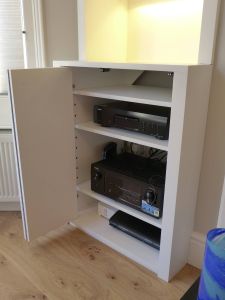
AV equipment often requires line of sight operation from an infra red remote control. To maintain operation with the cupboard doors closed, we fit magic eye repeaters. In the case above, a small, remote receiver was fitted discretely to the edge of the TV (out of shot), wired to small emitters within the cupboard. When zapped, the remote receiver relays the signal into the cupboard and the emitter then relays the zap to the target equipment; whether to change channel, increase volume, operate the satellite receiver and so on. All with the doors closed.
multi room music systems
We have fitted multi room music systems in most of our renovations. We invite clients to our home to play with ours, and they are hooked. Wifi multi room music equipment does not rely on direct line of sight; the controlling amplifier can therefore be hidden away easily, often operated by a free smartphone or tablet app. Although some multi-room music amplifier-speakers communicate wirelessly, we have found blind spots in properties so will still connect them to the home network where available. You can read our SONOS review here.

TV hidden in ottoman


For this TV in ottoman, we had to consider the practical size of the furniture and the size of TV that could fit in it. If you wish to perch on the ottoman in the morning to pull on your socks, this determines the seat height. Subtracting the frame thickness and lift mechanism leaves the height available for the TV. When deployed, the TV then needs to be visible above the duvet. Operated by remote control and fed with power from behind the bed, our upholsterer covered it in fabric to blend with the rest of the bedroom furnishings.
A number of fabricators have wrestled with the age old challenge of how to hide a TV. Other designs that you may have seen employ bed footboard which houses the unit. We’ve also seen solutions where the TV emerges from the top of a mock fireplace, from the rear of a sideboard, and from beneath the bed on an articulated mechanism.
Hiding a computer and cables


The images above show our design for a computer work station in a Georgian property. We maintained the classic feel of the surrounding joinery and mouldings, whilst hiding all the IT equipment. The cupboards provided additional storage, with mouse and keyboard on a pull out shelf to provide ample knee space. Note how the doors open then slide back into recesses either side of the screen like a TV in a hotel cabinet.
Although we’ve not fitted them ourselves, we have come across TVs that transform into mirrors – but remember that a mirror needs to sit at a certain height on the wall to look natural; higher than the usual comfortable viewing position for a TV. These mirror designs are therefore usually shown above a fireplace.
Home network and media hub

So we’ve shown how to hide a TV, but there are many other systems in a home that you may care to hide away. We usually find space for the home network and media hub in a home offfice. Alternatively, we create a cupboard beneath the stairs with good access when needed. All wires are then fed under floors emerging only where the RJ 45 sockets are located which in turn are hidden behind furniture.
Our start point is always the property’s floor plan. We then produce the home network schematic (example below). This is included in the electrical specification ensuring that the electrician routes power and speaker cables correctly, and fits back boxes in the right locations during first fix. As mentioned above, we site the router and network patch panel (the hub) in a home office, away from the comfy living space, or in cupboards or behind accessible hatches beneath stairs. We locate sockets and RJ45 points close to the AV equipment in cupboards and behind units. We also design any bespoke furniture at the start so we and our clients have a clear understanding of how the final design will look and function (along with the total price).

Disguising home entertainment equipment
Finally, it is worth spending a few moments considering disguises:
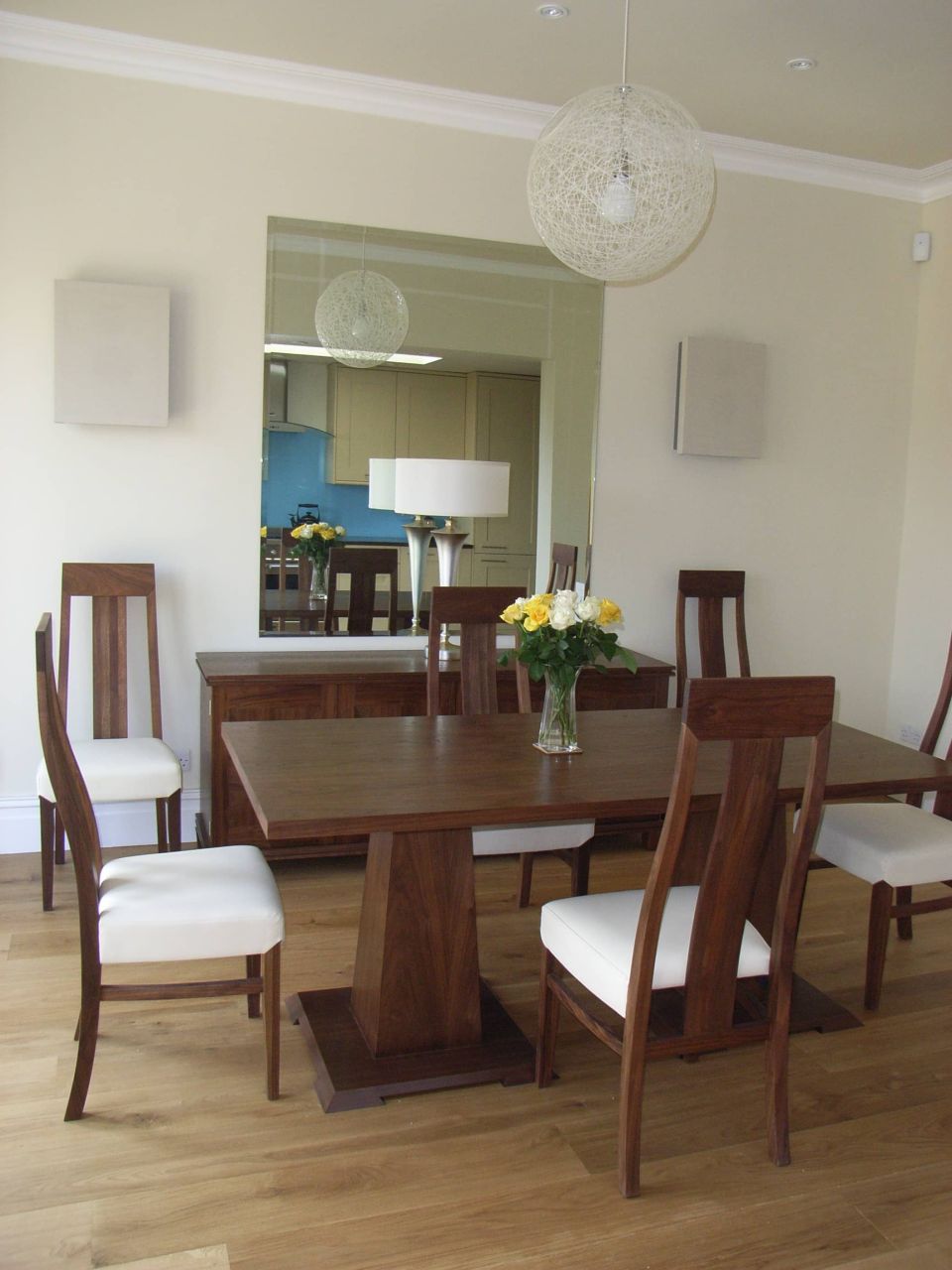
The two panels above the chairs are speaker grilles that we colour-matched to the walls. This is not a cheap option but the hifi system itself was also expensive. You can have pretty much any design you like for these types of speaker; perhaps a picture or photograph. Another company even produces plastered in speakers, although we’ve not taken this route ourselves.
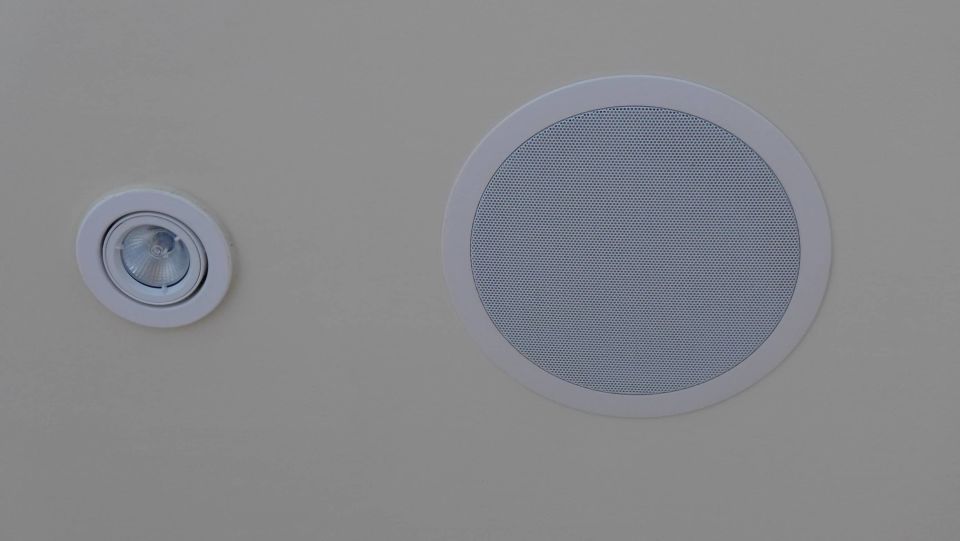
We fit ceiling speakers where possible, particularly in kitchens connected to a multi-room music system; they are very neat and unobtrusive. Ceiling speakers also work well as rear speakers for surround sound.
How to hide a TV
This blog has described several ideas for how to hide a TV. We’ve designed and installed all the examples above and many more. We hope you found this useful.
Whilst some clients want to know how to hide a TV, others are proud of their gadgets and want to show them off with style. If this applies to you we invite you to read more about our bespoke TV cabinets.

